Since its release in 1979, Ridley Scott’s Alien has been the focus of much scholarly attention. This scholarship has typically focused on two of the film’s most explicit themes: its critique of contemporary capitalism; and its challenge of patriarchal societal structures. In this paper, I consider how these topics are reflected in the film’s soundtrack, in an attempt to ascertain how film music represents and comments upon a film’s representation of political ideology and national identity.
Despite being directed by an English director, Alien is for all intents and purposes an American film–produced and distributed by American companies, featuring a predominantly American cast. In framing the film as an American film, I explore how it represents, celebrates, and challenges traditional understandings of the American national identity. I therefore propose additional ways of understanding and appreciating a film’s use of music: as a means to comment upon political and nationalistic ideologies. In this case, this pertains a focus on longstanding presumptions about the American national character.
Essentialising any national identity down to a select few characteristics is of course a highly fraught and potentially problematic task, and risks reducing gender, sexuality, and nationality into simple, binary terms. I aim to avoid such reductionism by basing my understanding of the “American" identity upon historical theory that has proven to be one of the most enduring and far-reaching attempts to codify the American national character.
In this, I draw upon Frederick Jackson Turner’s “Frontier Thesis" from his 1893 paper “The Significance of the Frontier in American History," in which he claims that the nation’s westward expansion shaped its national identity.(Turner 1998) Turner’s thesis was immensely influential in its time, but has also been the subject of critiques that cite it as solely focused on the white male experience.(Evidence of the scholarly impact of Turner’s thesis is outlined by Allan Bogue who notes that, by the time of Turner’s death in 1932, his lectures on the history of the American west formed the basis of 60% of undergraduate history curricula in the country Bogue 1994, 195) And yet, despite this criticism, and the fact it is now well over 100 years old, the quintessential “American" figure that Turner described remains enmeshed within the cultural and political imagination.
Using Turner’s thesis as a key framework, I identify three attributes that supposedly define the American national identity: patriarchal domination, a rejection of European cultural signifiers, and an embrace of capitalism and free trade. As I discuss below, each of these characteristics are on display in Alien, and allusions to them can be heard within its soundtrack. I posit that through its use of original and pre-existing music, Alien laments the apparent downfall of the traditional American patriarch, and advocates for the return of regressive gender roles, while offering a critique of unfettered capitalism and European cultural identities.
Before moving onto my analysis of Alien, further interrogation of Turner’s thesis is required in order to justify its usage and relevance in this research.
Turner’s thesis–and his definition of American identity–foregrounds the impact of the western frontier and American expansionism in shaping and defining the American individual. For Turner, this westward expansion meant a repeated “return to primitive conditions on a continually advancing frontier line,” which in turn led to the American experience being one of “perennial rebirth.”(Turner 1998, 32) Historian Mark Cronlund Anderson expands upon this:
The trials and tribulations of the frontier, because it is dangerous … strip the man (not woman) of his cultural baggage. The alternative is death. The true frontiersman, once stripped-down, qua the prototypical American Adam, not only survives but prospers. He becomes American.(Anderson 2011, 318–19)
Anderson later elucidates Turner’s claims somewhat facetiously, referring to the need of “white immigrants” to shed their “sissified urban, eastern or effete European cultural rubbish.”(Anderson 2011, 318) Being a true American, Turner suggests, is thus predicated on the rejection of European civility in favour of a “rugged individualism … [and] mental and physical toughness” not previously attainable without exposure to frontier conditions.(Anderson 2011, 319) Anderson’s summary points to Turner’s near total focus on the frontier experiences of white men, at the expense of women and people of colour, issues referenced by many of Turner’s critics.
Megan Mondi, for example, criticised Turner’s claim that the frontier was “an area of free land” by noting that this freedom was not extended to women.(Mondi 2006, 31) Mondi concludes by asserting that, when Turner “spoke of Americans, he was not speaking about women.”(Mondi 2006, 31) Historian Margaret Washington, meanwhile, notes that Turner “makes no mention of blacks, and their role in frontier development probably never crossed his mind."(Washington 1993, 232) She goes on to name several African American figures who “had [they] been white … would appear in textbooks as a western archetypical hero."(Washington 1993, 232) The only reference Turner makes to the experience of African Americans is in passing reference to what he refers to as “the slavery question,” which he argues will come to be seen as merely an “incident” in the holistic perspective of American history.(Turner 1998, 48) In Turner’s telling, white masculinity is presented as an assumed facet of the “true” American ideology and identity.
His conscious ignoring of non-white male experiences extended to Native peoples that white settlers encountered. He attempts to justify this by framing westward expansionism as a process of civilising and taming the savagery west of the westernmost frontier. However, he downplays the systematic genocide of Native Americans that this “taming” required. When Turner does discuss Native American traders, he does so only as a means to celebrate how white settlers demonstrated their entrepreneurial acumen in “undermining Indian power” in the midst of a hostile environment.(He poses Native Americans as a “question” that early settlers had to address before continuing their expansion Turner 1998, 37–40) Their capitalist and entrepreneurial ingenuity is evidenced here in their selling of guns to native peoples. However, he claims that the apparent nobility and admirable sufficiency of these settlers was turned against them by some Native Americans who used their new weaponry against frontier farming communities. This industriousness thus becomes synonymous with the frontier experience and the American identity.
While his paper discusses many aspects of frontier life and its economic and societal infrastructure, Turner’s thesis can be crystallised into three fundamental components that define the American identity: individualist self-sufficiency; a rugged and traditionally “masculine” toughness, in direct contrast to the supposedly more effete European; and an embrace of capitalism and mastery of trade and entrepreneurialism. For Turner, these attributes allowed those on the frontier to survive and develop the economic and social characteristics that came to be understood as intrinsic to the American psyche. These characteristics laid the groundwork for what bell hooks describes as the dominant “white supremacist capitalist patriarchy” that continues to assert its supremacy, thus, I argue, justifing its usage here..(hooks 1994, 197)
Despite legitimate critiques surrounding the racism and misogyny of Turner’s thesis, its legacy can be seen throughout the years since its publication, specifically in cultural and political ideologies. Anderson noted this in a 2011 paper in which he both critiqued the assertions made by Turner and justified their continued relevance in studies of American history: “the thesis articulates, with real and enduring accuracy, Americana’s core self-perceptions, however empirically inaccurate they may be."(Anderson 2011, 320) Patricia Nelson Limerick, in 1995, doubted that this relevance would diminish in an article wherein she considered the resilience of Turner’s claims in the face of countless critiques: “After a century of holding their ground, they are not going to disappear in response to the latest frail protest against their power."(Limerick 1995, 697)
The significance of the characteristics laid out by Turner can be seen, for example, in the political realm as polls show voters often predicate their support for political leaders on their demonstrating of such characteristics. The political success of Donald Trump is largely predicated on this, with polls and studies suggesting much of his support derives from his performance as a successful businessman and “masculine protector who could successfully restore America from its feminized state."(Vescio and Schermerhorn 2021, 2; See also, Newport and Saad 2016)
The thesis is exemplified in film typically through narrative and character archetypes, which often portray and celebrate figures who represent these characteristics. Michael Ryan and Douglas Kellner, in their study of political ideology in 1970s and 80s film, write that such this representation of “male heroism" has “been a traditional way of reproducing male dominance in the political, economic, and domestic spheres. That strategy is given a specifically conservative ideological inflection in the late seventies and early eighties."(Ryan and Douglas 1988, 217)
The mostly-male heroes that were depicted during this period, Ryan and Kellner argue, typically represented three key characteristics: they are warriors who “buck government power and stand up to state tyranny”; they are entrepreneurs, in that they are demonstrate a “callousness and … survivalist mentality of the market”; and they are patriarchs, “who [dominate] women.”(Ryan and Douglas 1988, 219–20) In other words, they are representative of the figure outlined by Fredrick Turner.
The fulfilment, or indeed the failure to fulfil these characteristics, is a core fact of Alien. As I will argue, we can understand the score commenting upon this, and therefore the film’s representation of the American national identity.
Alien depicts the voyage of the intergalactic commercial towing vessel Nostromo, its seven crew members and their cat, Jones. A title card during the opening credits explains that the crew is returning to Earth after an assignment from their employers, the unnamed Company. The film opens with the crew being wakened from cryogenic sleep and instructed to investigate an intercepted transmission from a nearby planet. The ship’s seemingly cognizant computer system, Mother, changes the ship’s course upon receiving this message and the crew are contractually obligated to investigate. This investigation takes the crew to a desolate planet, where executive officer Kane discovers an egg. This then hatches a creature that breaks through his helmet and attaches to his face. Kane is brought back on board the Nostromo with the creature still attached to his face–a creature later dubbed a Facehugger–despite the protestations of warrant officer Ripley, who repeatedly points out this is a violation of quarantine regulations. He is placed in the medical bay under the supervision of science officer Ash, and the Facehugger is finally removed. Kane appears to make a full recovery but during his next meal an alien bursts from his chest and escapes. The rest of the film depicts the remaining crew trying to capture the alien while it kills them off one by one.
At one point, Ripley is left as the highest ranking crewmember and attempts to speak with Mother. She learns that capturing the alien was the original purpose for their mission, and the crew have been deemed “expendable." It is then revealed that Ash is an android, and has been following the Company’s orders to capture the alien the whole time. Eventually, just Ripley and Jones remain. They evacuate the ship in the escape pod, where they are attacked by the alien. Ripley kills it by ejecting it from the pod, and the film ends with her placing herself and Jones into hypersleep.
Alien’s soundtrack was composed by Jerry Goldsmith, and can be heard for roughly 48 minutes of the film’s 1 hour and 51 minute runtime. As is typical in the horror genre, the score is predominantly used to create an unsettling atmosphere throughout the film. Goldsmith achieve this by combining classical, neo-Romantic instrumentation, unconventional instruments–such as didgeridoos and serpents–and non-musical sounds–such as whale song and an electronically created heartbeat.
In the documentary Lauzirika (2003), Jerry Goldsmith describes his affinity for science fiction and the possibilities of space. He couched this affinity in noticeably Turneresque terms, drawing parallels with Turner’s celebration of the conquering of the frontier: “space is a very romantic thought. It is, to me, like the Old West, we’re up in the universe. It’s about discovery and new life."(Goldsmith, quoted in Mormanni 2021) He subsequently approached the score with the intention to connote a sense of romanticism in the film’s opening, so as not to “give it away in the main title,” referencing the impending horror that would later unfold.(Lauzirika 2003, 02:11:36)
Such intentions, however, were undermined as director Scott insisted on a more sinister, dramatic opening cue to set the sinister tone early in the film, forcing Goldsmith to rewrite much of the score. His score was then heavily edited, and placed into scenes different to those for which Goldsmith had composed them.
Goldsmith’s score was further rebuked, as temp tracks used by editor Terry Rawlins while editing the film were purchased by Twentieth Century-Fox and used in the theatrical release. Some of these cues came from another Goldsmith-composed film, Freud: The Secret Passion (John Huston, 1962), and were purchased without Goldsmith’s knowledge. Another temp track used in the final version of the film was Howard Hanson’s “Romantic" Symphony no. 2. Though each of the compositions utilise symphonic orchestras, they represent different stylistic approaches to these forms. Beyond the music’s aesthetics, however, is the obvious power imbalance between composer and the filmmakers.
The film’s production therefore displays something of a rejection of Turner’s celebrated aspects of the frontier. When faced with the disagreement between Goldsmith and Scott regarding the correct tonal approach, the production company demonstrated their own capitalist supremacy in purchasing Freud’s publishing rights to resolve the impasse. This draws parallels with the film’s narrative: Scott and Twentieth Century-Fox representing the Company that the film is condemning, while the crew’s plight and their lack of individual autonomy mirrors Goldsmith’s, whose remit ultimately lay at the whim of the managerial classes above him.
A similar situation unfolded with Howard Hanson, who was unaware his symphony was used in the film’s finale. He later claimed that his publisher granted the rights to use the cue without consulting him, and he only found out that his music had been used after the film’s release.(Cohen 2004, 24–25) Once again, this points to composers’ loss of autonomy over their composition within a rigid capitalist structure that favours film studios and publishing houses.
We are therefore faced with a contradictory approach to capitalist ideologies. For while the film critiques the Company’s pursuit of profits at the expense of the crew, the treatment of Goldsmith and Hanson mirrors a similar approach to employees’ individualism. Both Twentieth Century-Fox and the Company are thus portrayed as employers fundamentally insensitive to the desires of their employees and contractors. And yet, despite the real-world significance, the critique of capitalism can still be heard at numerous points in the film.
The film begins in near total darkness, except for the tiny specks of distant stars. Unconventional instrumental techniques evoke the sound of blowing wind and the scraping of metal, and are the only sound on the soundtrack for roughly 15 seconds. During this time the spectator is left in the dark with just the eerie sonic accompaniment, establishing an ominous tone from that film’s opening. The metallic scraping effect–created by a string section playing sul ponticello–further puts the audience in discomfort, using unfamiliar sounds to connote an unfamiliar world. These sinister tonalities present this environment as hostile, unrecognisable, and dangerous from the film’s opening. Goldsmith’s original intention, as outlined above, was to present space as a place of mystery and romantic exploration, more aligned with the Turneresque vision of the frontier as a place of endless possibilities for personal and national growth. By establishing a foreboding and threatening tone, this opening sequence instead rebukes such an optimistic vision of this new frontier and the colonial pursuits its exploration involves.
The primary melodic feature of this sequence is what has been termed the “time motif," which, for Kristopher Spencer, represents “the deep, lonely reaches of outer space."(Spencer 2008, 203) The time motif recurs several times in this sequence, with each instance slightly altered. First alternating from B-A-B, it then expands to B-A-C-F-B, before a mode-preserved modulation to C-A-C-G.(Mode-preserved modulations, as defined by Frank Lehman, are modulations wherein each note is transposed by the exact same interval, thus creating a “verbatim" repeat in a new tonal centre. Lehman 2018, 54) These latter two iterations are suggestive of B Phrygian and C Phrygian respectively, a mode typically used to denote a strong sense of foreboding, further heightening the sense of anxiety instilled throughout the film’s opening.
As this C Phrygian time motif plays, a spaceship enters the frame and text appears on screen introducing the ship and detailing its cargo: “mineral ore" mined from another, unseen planet. After the motif and the title card fade, the camera remains on the ship as the soundtrack is dominated by machine rumblings which seem to be generated by the ship’s engine. The Nostromo passes the camera before cutting to the ship’s interior.
A series of tracking shots move through the Nostromo’s empty corridors provides the spectator a tour of the ship. The tour through these deserted corridors, with the continued, unsettling machine droning, introduce the ship as a largely creepy location, with the spectator likely wonder what has happened to the crew. The seemingly abandoned ship takes on an ominous atmosphere akin to what Carol Clover would describe as a “Terrible Place.”(For Clover, the Terrible Place is the sinister location “in which victims sooner or later find themselves and is a venerable element of horror.” Clover 2015, 30)
The soundtrack is first dominated by a continuation of the humming machinery that began when the camera was showcasing the ship’s exterior. A sporadic series of flute motifs join the soundtrack, alternating between perfect fourths and followed by a low string drone. The flute motif is played through the Echoplex tape delay unit which imbues the motif with an otherworldly, dream-like quality. This timbre evokes a somewhat exciting sense of wonder well suited to the futuristic setting, and in stark contrast to the ominous string drones and unsettling mechanical room tone.
The tour of the Nostromo culminates with a static shot of a helmet placed upon desk. A computer screen springs to life, emitting a series of whirrs, drones, and buzzes. We soon learn this computer system is the seemingly cognizant “Mother,” the ship’s ultimate authority who provides instruction, guidance, and support to the crew. Mother is thus representative of a subversion of the traditional gendered power dynamics that Turner endorsed.
The camera then cuts to darkness. Lights slowly switch on, illuminating a short, white corridor and the camera moves along the corridor toward a door. As the lights turn on, Goldsmith’s score returns with another series of Echoplex flute motifs, high sustained strings, and a synth pad performing chordal triads (Figure 1). The flutes’ delay effect is reduced which diminishes their otherworldly quality, while their warm timbre is complemented by the strings’ sustained B.
The synth pad’s triads make the chordal sequence explicit in this cue, with Goldsmith utilising a pantriadic chord sequence: Em→ Bm→ Cm→ G → Bm → C♯m → Am → Bm → E♭m → B♭m → F+ → A. In his study on the sound of wonder in Hollywood cinema, Frank Lehman asserts that such tonality has been “used throughout film music history to represent and sometimes elicit the affect of wonderment."(Lehman 2018, 10. Italics in Original) Whereas the earlier droning strings created a sense of dread beneath the oscillating flutes, the brighter timbres and pantriadic chordal sequence here evokes a sense of wonder, building anticipation as to what might be found behind the door that the camera is tracking toward.
As the camera approaches the door at the end of the corridor, it slides open revealing a dark inner room. The camera continues forward and the flutes’ motifs transition to triplets, heightening the excitement even further. A brief ascending flute run precedes a series of rapid string arpeggios. These arpeggios are synchronised with lights in this small room slowly fading on, revealing a circle of enclosed beds where the crew are held in hypersleep dressed only in their underwear. The lids over the beds begin to open slowly while the strings arpeggios gradually ascend. When lids fully open and the lights are switched on, the strings climax on a celebratory Dmajor chord, giving a tremendous sense of triumph and celebration. A camera dissolve centres Kane as he slowly wakens, and sits up with his eyes closed (Figure 2).
Much has been written about this scene and the sleeping chamber, with many scholars citing its sexual imagery. Barbara Creed, for example, refers to this room as “womb-like,” and discusses the crewmembers emergence from their pods as “a rebirthing scene.”(Creed 1993, 18) Stephen Scobie, meanwhile, argues that this room contains seven individual wombs, one for each of the crewmembers.(Scobie 1993, 83) Such analyses certainly seems appropriate, as the crew are introduced as they emerge from their sleeping pods dressed in what amounts to babies’ nappies.
If understanding this sleeping chamber as the ship’s womb, when paired with the authority of Mother, the Nostromo appears coded as feminine.(Understanding the Nostromo as feminine follows many analyses of Alien, for example William Whittington, who cites the ships as akin to a living organism Whittington 2007, 155) Extending this further, with the arpeggios synchronised with the crews’ awakening, the score seems to stand for Mother’s voice waking the crew with the climactic Dchord. The major tonality and warm timbre of this tonic chord suggests a secure and nurturing environment. In addition to her position as the ship’s ultimate authority, Mother is therefore presented as carer for the crew, who in contrast appear infantile, demonstrated in Kane’s state of disorientation as he slowly wakes up.
This status quo that the film establishes here is therefore in direct opposition to that described by Turner as intrinsic to the American identity. For while the crew may mirror the intrepid explorers of the 18th and 19th centuries that Turner celebrated, they remain beholden to Mother, in a subversion of the patriarchal societal structure that the frontier thesis outlines. When considering Alien through the framework of the national American identity outlined by Turner–and the contemporary socio-political landscape that it has shaped–this status quo seems to be presented as inherently sinister. This perspective is echoed in the ominous score from the title sequences that established a sinister tone from the film’s opening seconds.
Mother’s superiority on the ship becomes evident throughout the film as the crewmembers defer to her for most decisions. However, as we later learn, this authority is used to inhumane and malicious ends, with the prioritisation of profits over human life. That Mother is a computerised representation of the Company points to the obvious critique of unregulated capitalism as inherently inhumane. Perhaps the most obvious textual instance of Alien’s critique of capitalism, however, is in the characterisation of the Nostromo’s bourgeois management. We can hear this in the film’s only instance of diegetic music.
The sole occurrence of diegetic music comes in a scene wherein Ripley confronts Ash in the medical bay. In this interaction, she questions why he disobeyed her orders and broke procedure by allowing Dallas, Kane, and Lambert on board the ship after Kane had been attacked by the Facehugger (00:41:23). Their conversation begins tersely with Ash clearly unhappy with Ripley’s presence and line of questioning. As the conversation goes on, Ripley questions whether he “forgot” their science divisions quarantine protocol and Ash retorts by making the issue one of humanism:
Ash: Look, what would you have done with Kane? You know his only chance of survival was to get him in here.
Ripley: Unfortunately, by breaking quarantine, you risk everybody’s life.
Ash: Maybe I should have left him outside. Maybe I’ve jeopardized the rest of us, but it was a risk I was willing to take.
While Ash positions himself as willing to disobey the Company’s policies for compassionate reasons, Ripley demonstrates an unerring fealty to those same policies regardless of the situation, identifying herself as a loyal employee. Following this exchange, Ripley exits the room, leaving Ash alone. The camera stays on him while Ripley walks off screen and we hear the sound of futuristic automated doors closing behind her telling us that he is now alone. With Ripley having left the room, Mozart’s Eine Kleine Nachtmusik begins to play very faintly, and Ash follows her out the room. At this point, it is unclear whether the music is diegetic or not; while we did not see Ash pressing any buttons to turn it on, its gradual rise in volume and the generally low quality of recording sounds suggest that it is coming from within the film world.
Noted above, Ash is later revealed to be an android secretly working for the Company to bring back the alien. He is revealed then as one of the film’s primary villains. When we hear this Mozart cue, though, this fact is not yet known by the audience or the crew. Nevertheless, by associating him with this music, the film plays on longstanding tropes surrounding Classical music to subtly question his trustworthiness.
Music historian Theodore Gioia discusses the use of such Classical music in cinema, writing that it can be seen as “the trademark of villains,” given the preponderance of examples of films that feature sinister characters associated with this style of music.(Gioia 2019) Such contemporary examples can be heard in Kubrick (1971), Schlesinger (1976), and Gilbert (1979), which all feature close associations between their antagonists and Classical music. Thomas Fahy also discusses this, citing two horror/thrillers films that came out much later than Alien but nevertheless continue the trope: Demme (1991) and Fincher (1995). For Fahy, “diegetic classical music helps characterize serial killers as aesthetes,” and “distinguishes them and their crimes from everyday violence, from the common criminal or thug.”(Fahy 2003, 28) Though Ash is not a serial killer, Fahy’s description of Classical music’s potential as cultural and class signifier, remains relevant for my purposes. Ash’s self-perceived class superiority is evident throughout the film: earlier in this scene Ripley fiddles with his microscope much to his annoyance, clearly seeing her as far too beneath his station to appreciate or understand the equipment; and when Parker and Brett attempt to negotiate a higher proportion of shares, it is Ash that ultimately shuts down their attempted strike, keeping them in their place. This latter point, Roger Luckhurst notes, identifies Ash as “a stickler for order and rules … whose word-perfect recall of their contractual status sends them after the fateful signal, whose inexorable logic grinds potential mutiny down.”(Luckhurst 2014, 66) He is therefore the antithesis of many Seventies Films protagonists, as he is essentially–and as we later learn, literally–the embodiment of the corporate machine that attempts to quash any displays of individualism and nonconformity.
Following the scene described above, after Ash leaves the medical bay, the camera cuts to an exterior shot of the Nostromo. The Mozart cue can still be faintly heard here, before a cut to inside the Nostromo’s escape shuttle where Dallas is sitting. The cue’s diegetic status is made clear after Dallas switches a button and the music abruptly stops.
Whereas the music seemed previously to insinuate Ash’s untrustworthiness through audiences’ association of Classical music with villainy, in Dallas’s case it seems to point more to his position as the ship’s captain and apparent authority. Dallas differs greatly from Ash, and he does not demonstrate the same sense of nefariousness. Rather, he evokes many characteristics typical of many 1970s blue-collar protagonists in his physical appearance–his beard, unkempt hair, and informal body language–and his persona–his general ambivalence to their mission, and his uninterest in the hierarchical and personal disputes among the crew (Figure 3). He thus seems associated with the archetypal 1970s “unmotivated hero,” discussed by Thomas Elsaesser.(Elsaesser 2004, 279–92) Luckhurst furthers the connection between Elsaesser’s unmotivated heroes and Dallas, pointing to his “sense of deflation and defeat. He wants only a simple contract, a quiet life, and is exasperated by this deviation from a standard run back to Earth.”(Luckhurst 2014, 64) Despite his attitude and demeanour which seem to position him in opposition to the capitalist structures that Alien overtly critiques, his status as captain positions him firmly within the Company’s bourgeois management and above the rest of the working-class crew. His preference for Classical music similarly aligns him with a great many Hollywood characters for whom Classical music has been used to signify, as Gioia has claimed, their “haughty social background.”(Gioia 2019)
This scene comes while Kane is still incapacitated in the medical bay with the alien creature attached to his face. At first, this scene seems to be a simple instance of Dallas attempting to decompress during this uncertain time. However, listening to the music alone, secluded in the escape pod, suggests that Dallas wants to escape from his crew, and that he feels this music would perhaps preclude his acceptance by the crew. It further points to an arrogance and privilege of the bourgeois classes: while the engineers grumble about inequitable salaries, and middle managers squabble about hierarchies, Dallas’s role as captain positions him above such trivial matters. By avoiding addressing these concerns and physically removing himself from the rest of the crew, Dallas demonstrates that he feels these issues are beneath him. This points to capitalism’s disregard of proletarian concerns, for when Dallas removes himself from the legitimate debates his crew are trying to have, he represents neoliberalism’s lack of interest in such debates and its failings in providing for those seeking equality within its parameters. Following this, we can see in Dallas three of the seven characteristics that Gioia pinpoints as being imbued within a character through associations with Classical music: “continental sophistication” and “condescension”–each demonstrated in his desire to remove himself from populist concerns; and “illicit wealth and power”–demonstrated in his senior role within the unscrupulous Company.(Gioia 2019)
Though the cue here references Dallas’s bourgeois status, its significance regarding the film’s capitalist critique is evident when considering his ineffectiveness as captain. Dallas is presented as the Nostromo’s authorial figure, but it becomes apparent that he is not respected among the crew and is routinely disrespected and disobeyed. Despite his role as captain, he lacks much sense of individualism and is essentially a stooge of the Company, his only protest against the structures of the Company coming when he insists that Ripley forego scientific procedure and open the ship’s doors after Kane has been attacked.
Dallas’s identity as a bourgeois elite is made explicit by his preference for Mozart, and his ineffectiveness can be understood as a critique of the fecklessness and uninterest of upper management and capitalist structures toward anything other than the job at hand and the resulting profits. This sequence clearly plays on culture associations to align these characters with unscrupulous, dishonest, and ineffectual bourgeois classes. Perhaps more pertinent, however, is how it addresses another of Alien’s key themes: issues of gender and patriarchal dominance.
Despite his position as captain, Dallas holds very little real authority: he defers many key decisions to Mother; ignores the engineers’ resentment over financial inequality; and shrugs off Ripley’s suspicions about medical officer Ash. His ineptitude at commanding his crew, Roger Luckhurst asserts, places the film within the tradition of Gothic fiction: “many Gothic stories begin with the dysfunction of the father-figure whose failure of authority creates the conditions for disorder, invasion or haunting.”(Luckhurst 2014, 62–63) Luckhurst continues the characterisation of Dallas as the ship’s father figure, citing him as a powerless “patriarch without authority.”(Luckhurst 2014, 63) Extending this further, Dallas’s hiding in the escape shuttle calls the mind an absent father’s attempts to ignore his quarrelling children, namely Ripley and Ash. A more literal interpretation would suggest that he is avoiding his managerial responsibilities. Each of these readings point to Dallas’s lack of authority and unsuitability in leading the crew in their intergalactic expeditions.
Michael Ryan and Douglas Kellner wrote that the 1970s saw a “yearning for redemptive leadership on the part of the white middle class … [and] in the late seventies, images of strong heroes appear[ed] on the scene in apparent answer to that yearning.”(Ryan and Douglas 1988, 219) As the rugged, bearded, and supposedly authorial captain, typical filmic conventions suggest that Dallas should be this strong patriarchal figure. However, he is demonstrably lacking in each of Ryan and Kellner’s components of a contemporary hero: he is not an effective warrior, entrepreneur, or patriarch. His masculinity is undermined as he fails to evince such traditionally “masculine" attributes. He is further emasculated through his relationship with Mother which acts as the ship’s true authority, patronising him with the pretence of power while withholding the truth about the crew’s mission to capture the alien specimen.
The film’s soundtrack symbolises his emasculation through his taste for 18th century Viennese chamber music. His preference for this kind of music associates him with the cultural baggage that Turner argued must be shed in order to live beyond the frontier and belies his “masculine” image. The gendered and sexual politics of Classical music have long been debated, notably by Susan McClary who states that “classical music presents a wide range of competing images and models of sexuality, some of which seem to reinscribe faithfully the often patriarchal and homophobic norms of the cultures in which they originated, and some of which resist or call those norms into question.”(McClary 2002, 54) While the essential masculine/feminine nature of Classical music is debatable, when considered in the context of Turner’s frontier thesis its European nature must be seen in binary opposition to the domineering patriarchal figure that supposedly imbues the American national identity. Dallas’s choice of music therefore aligns him with a European identity that Turner’s thesis suggests is inherently feminine. He becomes associated with the “effete" European that stood in contrast to the rugged, masculine American that evolved along the western frontier.(Anderson 2011, 318)
While his actions out him as an ineffectual leader, ill-equipped for the responsibilities of frontier life, his European cultural tastes raise questions of his ability to survive in such conditions. Dallas subsequently becomes the alien’s third victim. We can hear in this sequence a clear lament to the fading dominance of the powerful, patriarchal figure, as the apparent leader of the Nostromo demonstrates his lack of interest in being the leader, while he is also presented as an avatar for ineffectual bourgeois structures and a representation of an effete European identity.
While Ash and Dallas are important figures to discuss when considering the film’s ideology, I turn now to the character of Ripley, who we learn to identify as the film’s primary protagonist and the subject of much critical discussion. Though I refer to Ripley as the protagonist, this is not made apparent until late in the film. Rather, the spectator instead seems encouraged to consider Dallas as the protagonist: he is the captain and leader of the crew; the first character with whom the spectator is left alone (00:07:57); and he is portrayed by Tom Skettit, perhaps the most famous actor at the time, and who is top-billed in the opening title sequence. Another potential primary protagonist is Kane, who is centred in the waking scene described above, the first character to speak, and the most proactive figure in the search party. Kane is of course the first character to die, though, roughly midway through the film, in a similar misdirect as seen in Hitchcock (1960).
Ripley does not drive the plot forward in the same way Dallas and Kane do, and is not involved in the exploration on the planet or the examination of the Facehugger. She instead seems largely reactive to the action unfolding, while her strict adherence to regulations and hierarchies–evidenced when she asserts her authority to not allow the search party back on board the ship–make her seem cold and inhumane. This latter point highlights Ripley’s apparent embodiment of contemporary, progressive feminism, as she steadfastly refuses to yield to her male superiors, citing bureaucratic regulations that grant her authority when Dallas and Kane are not aboard the ship.
Yet, as the film progresses, and the number of survivors dwindle, she becomes more active and clearly the spectator’s principal avatar before fulfilling the “Final Girl” trope outlined by Carol J. Clover. For Clover, the Final Girl archetype is more than simply a surviving female character, and can be described as “boyish, in a word … she is not fully feminine.”(Clover 2015, 40) Ripley’s place within this mould of “boyish” female horror characters has been a key point of discussion in analyses of Alien, and contemporary and retrospective reviews have celebrated the film and its sequels for its progressive depiction of female empowerment. Judith Newton, for example, writes that Ripley “appropriates qualities traditionally identified with male, but not masculinist heroes.”(Newton 1990, 84) Ripley’s representation of masculinity is signified for Newton in how she “is skilled, she makes hard, unsentimental decisions; she is a firm but humane leader; she has the hero’s traditional, and thrilling, resources in the face of the monster.”(Newton 1990, 84) For Luckhurst, it is most evident in her “lanky androgyny, her masculine height.”(Luckhurst 2014, 75) Ximena C. Gallardo and C. Jason Smith propose that Alien’s narrative presents an existential threat to patriarchal societies, most evident in the suggestion that when “women can become heroes and sole survivors, the male becomes superfluous.”(Gallardo and Smith 2004, 61) Clover challenges the notion that the Final Girl is a positive trope for feminism, however, adding that such characters act in essence as a “male surrogate” for the slasher films’ primarily male audiences, and refers to the celebration of the Final Girl as a progressive development as a “grotesque expression of wishful thinking."(Clover 2015, 53) This view is persuasive, for though Ripley demonstrates many laudable characteristics that Newton cites as male-coded, her character arc signifies problematic elements of patriarchal images of femininity. This is demonstrated as the film progresses and she begins to emulate more conventional tropes of female Hollywood characters, first through her relationship with the ship’s cat, Jones.
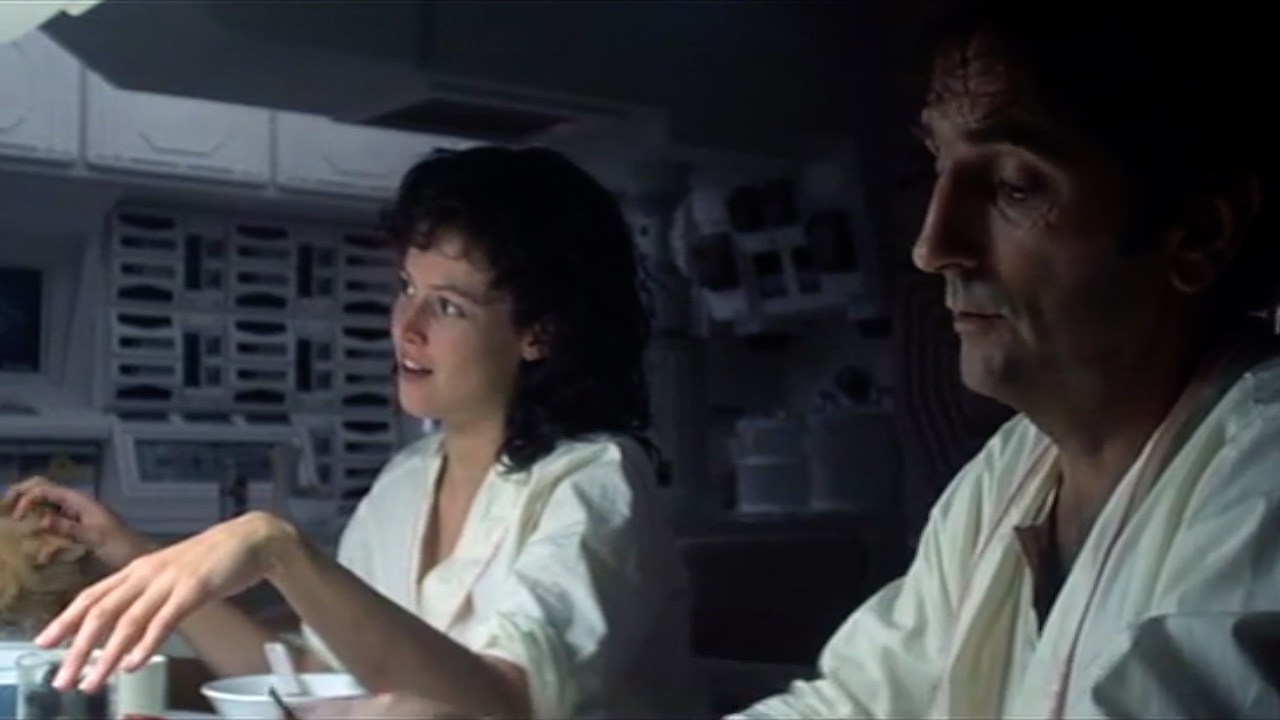
Jones is first seen during the first breakfast scene, sitting between the two female crewmembers, Ripley and Lambert. In a 1980 symposium on Alien, Tony Safford claimed that “the cat is a figure of domesticity.”(Byars et al. 1980, 298) This domesticity is extended to Ripley and Lambert by virtue of his position between them. He is noticeably closer to, and angled towards, Ripley, and she pets him as the crew discuss wages (Figure 4).
Jones’s domesticity becomes unmistakably associated with Ripley towards the end of the film as she searches throughout the ship to take him to the escape pod. This represents a significant character shift when considering Ripley’s previously anti-humanist and unsentimental actions, and aloof stoicism seen in her exchanges with the rest of the crew. As the danger mounts, Ripley prioritises saving the domestic signifier over ensuring she gets to the escape pod as quickly as possible. In the same symposium cited above, Judith Newton writes of her attempt to save Jones as “reinvest[ing] Ripley with traditionally feminine qualities.”(Byars et al. 1980, 296) This femininity is heard in her calling out to the cat, repeatedly and affectionately calling him “kitty” and “sweetheart” (01:27:20).
Ripley tries to find Jones after she has separated from Parker and Lambert, with each party tasked with helping to prepare the escape pod. When Ripley hears Jones’s meows, she is immediately distracted and instead prioritises the cat (01:25:22). She begins to search for Jones and is accompanied by one of the non-diegetic cues taken from Huston (1962), “The First Step” (01:27:15). Sonically, this cue is similar to much of the music written specifically for Alien, with solo woodwind and sustained strings. As in each of the cues analysed thus far, this cue contains a chromaticism that denies the spectator a clear tonal “home" and elicits a strong sense of unease.
The cue begins with a descending string motif which is repeated at increasingly lower octaves, and performed with a tremolo that adds to the tension through its unnatural and “shuddering" timbre. The strings’ gradual descent to an almost inaudibly low pitch exacerbates this uncanniness. This descent is followed by low, droning strings beneath a clavichord motif. A rapid ascending harp motif then reintroduces the descending strings return, this time accompanied by the harp. The cue is brought to an end as the strings hold an inverted pedal before Jones jumps out at Ripley.
Although not written for Alien, this cue fits the scene’s emotional tenor. and adheres to many horror scoring tropes, such as sustained, tremolo strings, extreme low and high registers, and atonality. It also mirrors earlier cues in its apparent projection of femininity. Much of the gendering of a film’s score is predicated on longstanding gender associations with the chosen instrumentation. Based on many of these associations, “The First Step" seems to exclusively use instruments that have been understood as representative of femininity. In a 2008 meta-analysis of gender stereotyping of instruments, for example, John Eros writes that “research literature presents few disagreements that ... high woodwinds (flute, oboe, clarinet) and high strings (violin) are female stereotyped."(Eros 2008, 58) Rita Steblin, meanwhile, cites the clavichord’s historic reputation as “the preeminent female instrument.”(Steblin 2013, 140) When understanding the instrumentation–and by extension the cue as a whole–feminine, this subsequently associates Ripley with a femininity that she previously did not apparently embody or represent.
James Buhler writes that music itself has long been coded as feminine, and he cites the “convention developed in silent film of associating the primary recurring theme of a film with the heroine."(Buhler 2018, 205) Buhler draws on Claudia Gorbman’s argument that during the studio era, music was regularly used to indicate “the presence of Woman on screen. It is as if the emotional excess of this presence must find its outlet in the euphony of a string orchestra.”(Gorbman 1987, 80) In direct contrast with these conventions, this is the first instance where Ripley is directly associated with a musical cue, as all other occurrences of music are heard when she is on screen with a number of other crewmembers. Following the assertion that the presence of music points to the presence of femininity, it is of note that Ripley is granted a soundtrack only once she begins to eschew her “masculine” traits and exhibits patriarchal visions of femininity, specifically in trying to nurture and protect Jones, the domestic signifier. The soundtrack and the “feminine” instruments heard in “The First Step" notes this transition by, per Gorbman, acknowledging the sudden emergence of Ripley as a “Woman.”(Gorbman 1987, 80)
After Ripley finds Jones, she hears via the radio the other final surviving crewmembers, Lambert and Parker, get killed by the alien. She initiates the Nostromo’s self-destruct sequence, and finally gets onto the escape shuttle. Here, her regression to a patriarchal image of feminisation is complete. This sequence sees Ripley remove her clothes down to her underwear, thereby becoming the unwitting subject of the camera’s voyeuristic male gaze, and her character seemingly transitions from a strong, individualist hero to an unprotected and sexualised object of desire. It also completes her transition from “boyish” femininity to an embrace of patriarchal ideals of femininity, and upends the film’s utopic vision of a post-gender-binary workplace.
While Ripley is in this state of undress, the alien suddenly appears and lurches its hand toward her. Ripley slowly backs away, slips into a spacesuit, and opens the door, blowing the alien into space. She is again associated with music when she attempts to remain calm by singing to herself, repeating the title line from the song “You Are My Lucky Star,” a song most likely known to audiences from its use in Kelly and Donen (1952). Ripley’s close-miked, breathy repetition of the song’s lyrics suggests an uncomfortable intimacy between the alien and the almost-naked Ripley, thus making another reference to slasher films and their tropes outlined by Clover by adding allusions to sexual violence.(As Clover notes, in many slasher films, the killer “must kill women who arouse him sexually.” Clover 2015, 26–27)
A Goldsmith cue with harsh brass timbres and high, sustained strings mirrors the tense showdown, before Ripley opens the pod’s door and shoots the alien with a harpoon, projecting it into outer space. The alien tries to crawl into the pod’s engines but Ripley fires them up, finally killing the alien. As the alien is blasted away from the engines, a final piece of music is introduced, Howard Hanson’s “Romantic” Symphony no. 2.
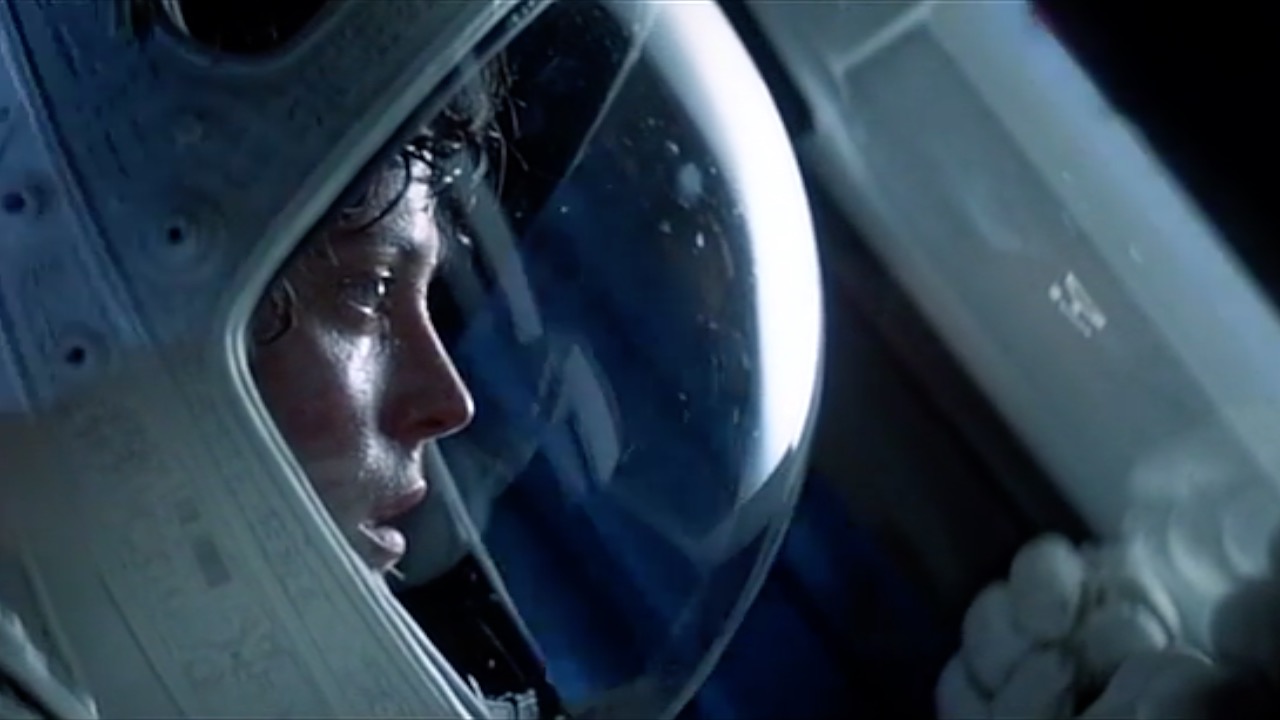
The music is first heard beneath the roar of the ship’s engines, and becomes more prominent as the camera cuts to a close-up profile shot of Ripley staring out the window (Figure 5). French horns soar over the rest of the ensemble during this shot, associating the score with her directly. The horns imbue the cue with a melancholic sense of victory through its timbre and associations with nobility and heroism–representing the dual gendering of the Final Girl.(Erika Wilsen discusses French horns and their association with melancholy, nobility, and heroism in her theses on the horn solos in Hollywood film. She writes that they connote contrasting qualities: “strong, brilliant, heroic, military, and epic,” and “love, memory, nostalgia, loss, and grief.” Wilsen 2021, 63)
Ripley then records a transmission for the Company, detailing the fates of her colleagues and the Nostromo. This transmission sees Ripley fulfilling her duty as a loyal employee, despite the Company’s blatant exploitation of her labour. The film ends with Ripley putting herself and Jones into hypersleep, the symphony continuing throughout the credits. For Newton, this final sequence sees Ripley transition away from a progressive female hero, unencumbered by patriarchal ideals of femininity, and sees her “reinvested with feminity” and “reaffirmed as a Company Woman.”(Newton, in Byars et al. 1980, 296)
Composed and first performed in 1931, Hanson’s symphony offers a tonal shift from Goldsmith’s score.(Lenti 2009, 48) Whereas Goldsmith’s cues–both those composed for Alien and his recycled cues from Huston (1962)–exhibit overt modernist tendencies and extended instrumental performance techniques, Hanson’s symphony employs more traditional Romantic instrumentation and tonalities. Hanson’s biographer, Allen Cohen, notes that this embrace of Romanticism was a “conscious gesture of defiance against the anti-Romantic spirit of the times.”(Cohen 2004, 24) He quotes Hanson himself, explaining his aim to “create a work that was young in spirit, lyrical and romantic in temperament, and simple and direct in expression."(Howard Hanson, quoted in Cohen 2004, 24) He sought to achieve this by adhering to Romantic symphonic practices, making ample use of legato, dramatic shifts in dynamics, tonal melodies, and a full symphonic orchestra including woodwind, brass, string, and percussion sections.
The more consonant and diatonic tonalities here suggest a triumph and return to a status quo far more appealing than that established in Alien title sequence. Played after Ripley’s transformation, Hanson’s symphony thus suggests that both the alien and Ripley’s masculine-coded femininity had fundamentally threatened the patriarchal order that Turner insisted the USA was founded upon. Having embraced a traditional, patriarchal notion of femininity, Ripley’s threat to patriarchal dominance is removed and the threat is defeated.
When analysing Alien through the prism of American identity, Hanson proves a fascinating choice of composer to close the film with due to his reputation as an “unquestionably American composer,” as he was described in a 1936 paper by fellow composer and musicologist Burnet C. Tuthill.(Tuthill 1936, 140) Hanson himself seemed to actively seek this reputation through his championing of the burgeoning “Americanist music project” that attempted to establish a uniquely “American” style of composition.(Ansari 2018, 29) This project, summarised by Emily Abrams Ansari, reflected his nationalist belief in “the moral rightness of American assertions of political power.”(Ansari 2018, 31) His efforts inspired composer Martha Alter to claim that “the name of Howard Hanson means American music to me.”(Alter 1940, 84–88)
For Hanson, developing a unique, Americanist music was a principal concern, and believed that the integration of European artists and influences threatened to undermine the “vitality” of American culture.(Ansari 2018, 29–30) He notably claimed in 1924 that “[Americans] have arrived at a point where we have something of our own to say … Europe is a comparatively old civilization and her expression has become blasé, while we are young, virile, vigorous.”(Hanson, quoted in Kalyn 2001, 5) In evoking virility, Hanson ties together the concepts of Americanness and masculinity. If we are to understand that Hanson’s music is therefore aspiring to represent an American patriarchal masculinity, its use during Alien’s finale furthers my above claim that the narrative ends with a return to a restored, if damaged, patriarchal status quo.
In unabashedly attempting to promulgate a “virile” national identity through music, Hanson encouraged his fellow composers to embrace “artistic nationalism and [reject] the illusion of ‘internationalism’ in art.”(Ansari 2018, 31) He similarly advocated heteronormative notions of masculinity in his role as director of the Eastman School of Music, which he held from 1924 until 1964.(Emily Abrams Ansari describes this role as a “bully pulpit,” adding that Hanson’s nationalism bordered on xenophobia. Yet, despite this encouragement of a new, American style of composition, Hanson nevertheless drew influence from European traditions, a contradiction he justified due to his Swedish ancestry Ansari 2018, 29–30) This was done through his encouraging of Americanist compositions, but also in “purges of homosexuals,” described by David Diamond, a gay composer who attended the school in the 1930s.(Schwarz 1994) Hanson can therefore clearly be seen to not only build upon Romantic compositional practices, but also problematic cultural traditions within Classical music which, according to Susan McClary, sometimes “reinscribe faithfully the often patriarchal and homophobic norms.”(McClary 2002, 54)
His political ideology, advocacy for cultural imperialism, and attempts to assert his work as a signifier of American nationalism and identity help draw direct links between his symphonies, Alien, and Turneresque understandings of the ideal American figure. His symphony in Alien’s conclusion therefore represents a reaffirmation of an American identity, represented most vividly by Ripley once she regresses to a more “traditional" image of femininity while still recognising her subservient place within the capitalist structure.
Ripley’s character arc–from a gender binary-defying, masculine-coded femininity to a patriarchal ideal of a nurturing and sentimental image of femininity–suggests that patriarchal views on gender roles and identity remain firmly in place, despite the frailties of male authority. Her previous progressive, anti-humanist, individualistic identity runs contrary to Turner’s male-oriented vision of a patriarchal society, in which he does not even bother to mention the role of women, as well as Hanson’s prioritisation of a virile, heteronormative, and patriarchal society. She therefore embodies the feminine image implicitly condoned in the frontier thesis, and represents the American identity Turner outlined while retaining her proactive autonomy which enables her to defeat the alien. The triumphant Romantic score celebrates this reaffirmation of a feminine gender identity, suggesting a desired return to a conservative vision of womanhood. This is in direct contrast with the atonality, dissonance, and unnatural timbres heard in the title sequence which presented this world as off-kilter and abnormal from the beginning. Alien’s finale can thus be read as a rebuke to the progressive feminism that it is often celebrated for advocating.
Perhaps more subtly, the Hanson cue similarly subverts the earlier critique of capitalism. As discussed above, this is one of the film’s primary themes, and the association of Mozart with Dallas and Ash points to the criticism of bourgeois figures within the capitalist structures of the Company. Ripley, however, demonstrates her commitment to following her orders and official procedure when she records her report and identifies herself by her position within the Company, “third officer reporting” despite knowing the Company’s culpability in the deaths of her colleagues and the traumatic experience she has undergone (01:52:39). Hanson’s luscious strings ascribe a great deal of poignancy to this transmission, appropriate to Ripley’s tone and the tragedy of the crews’ deaths. They also associate the bourgeois class connotations of Classical music to Ripley in much the same way as Mozart was associated with Dallas and Ash. The film thus concludes with Ripley–a loyal and subservient middle manager–fulfilling her role within the capitalist structures, soundtracked by a style of music we have come to understand as evocative of the bourgeois classes the film previously critiqued.
As I have noted above, Alien is often celebrated as a groundbreaking film in its positive representation of feminist ideals, and for its critique of nefarious, neoliberal market forces. I have simultaneously argued, however, that such assumptions of the film’s themes are simplified, if not largely misplaced. The film’s critique of capitalism is of course most evident in the Company’s sinister plot to capture the alien at the expense of its employees lives. The threat the Company pose is physically embodied in Ash, whose association with Mozart’s Eine Kleine Nachtmusik alludes to his position as antagonist, as well as his bourgeois status within the Company. Dallas, who is more closely associated with Mozart, is tarred with the same brush. However, while Dallas is not identified as an overt antagonist, linking him with bourgeois, European tastes suggests his failure to embody the Turneresque American identity. As such, he is unsuited to the contemporary image of heroes–outlined by Ryan and Kellner–and represents the apparent failings of modern masculinity. While Dallas and Ash each fail to fulfil the celebrated American ideal outlined by Turner, Ripley’s character arc sees her slowly transitioning into the female role that Turner tacitly endorsed: nurturing, subservient to capitalist structures, and a participant in the male gaze. The use of Howard Hanson’s symphony reflects this shift in her character, and Hanson’s own stated desire to establish a masculinist musical representation of American identity seems to suggest the soundtrack’s approval of Ripley’s change in character.
With this reading, Alien’s soundtrack helps to depicts a world in which Fredrick Turner’s ideal American character is celebrated, as those who fail to fulfil the characteristics he lays out are unable to survive. As Ripley’s triumph comes once she has regressed to a model of femininity Turner may likely have approved of, we can understand the film as representing a conservative ideology surrounding its characters’ national identities.